What to Check When Buying a New Battery
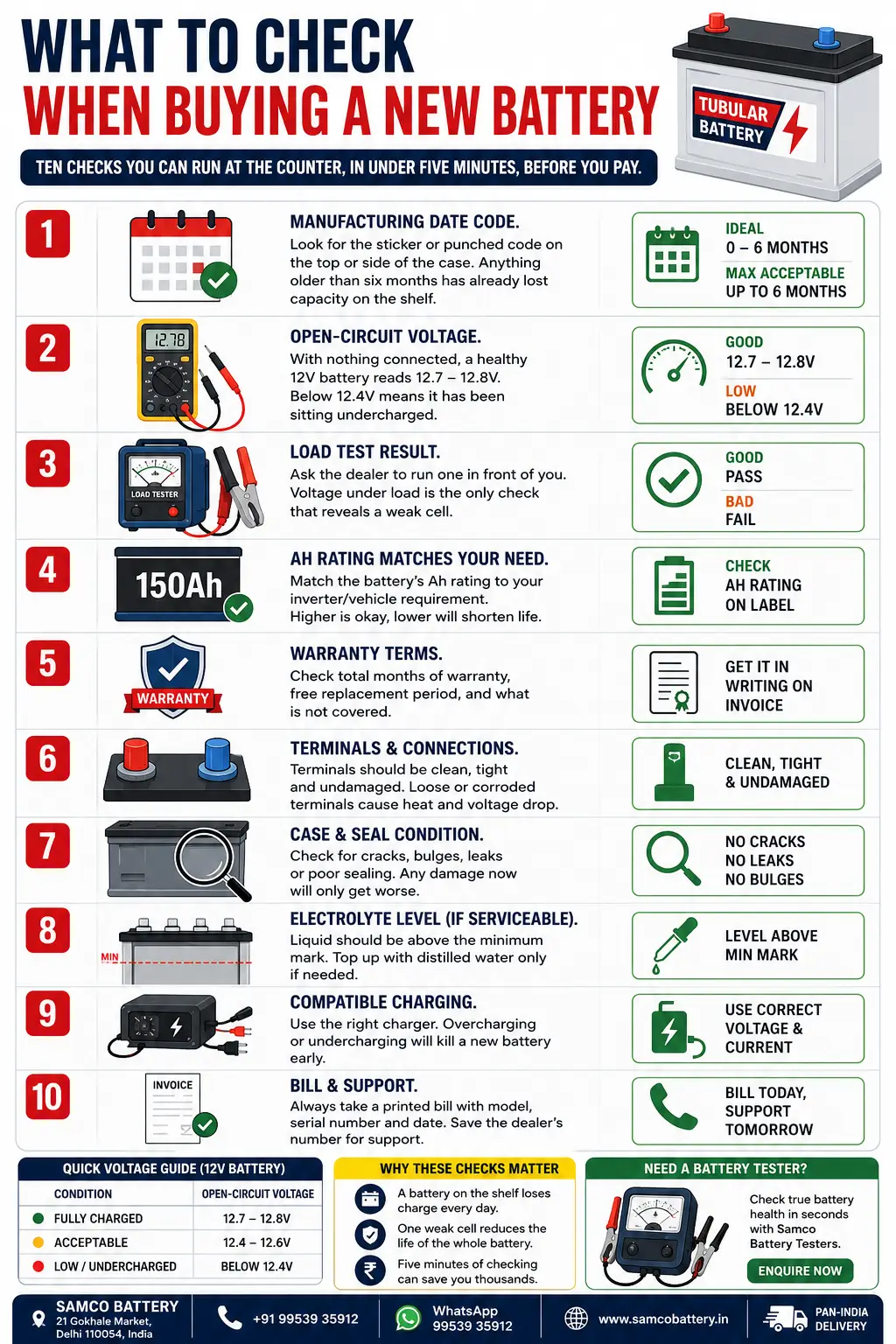
Ten checks you can run at the counter, in under five minutes, before you pay. Most disputes later trace back to something skipped here.
A "new" battery is not always a fresh battery. Stock sits in warehouses, self-discharges, and sulphates. The cell that has been on a shelf for eleven months is sold at the same price as the one made last week, and it will not last as long. The checks below separate the two.
The 10-point checklist
- 1Manufacturing date code. Look for the sticker or punched code on the top or side of the case. Anything older than six months has already lost capacity on the shelf.
- 2Open-circuit voltage. With nothing connected, a healthy 12V battery reads 12.7–12.8V. Below 12.4V means it has been sitting undercharged.
- 3Load test result. Ask the dealer to run one in front of you. Voltage under load is the only check that reveals a weak cell.
- 4Ah rating matches your need. Match the battery’s Ah rating to your inverter or vehicle requirement. Higher is okay, lower will shorten life.
- 5Warranty terms. Check total months of warranty, free replacement period, and what is not covered.
- 6Terminals and connections. Terminals should be clean, tight and undamaged. Loose or corroded terminals cause heat and voltage drop.
- 7Case and seal condition. Check for cracks, bulges, leaks or poor sealing. Any damage now will only get worse.
- 8Electrolyte level (if serviceable). Liquid should be above the minimum mark. Top up with distilled water only if needed.
- 9Compatible charging. Use the right charger. Overcharging or undercharging will kill a new battery early.
- 10Bill and support. Always take a printed bill with model, serial number and date. Save the dealer’s number for support.
1. Read the date code first
Do this before anything else, because it decides whether the rest is worth your time. Indian manufacturers use a few formats — a month/year sticker, an alphanumeric punch, or a colour dot system that varies by brand. If the code is unreadable or the sticker has been peeled, treat that as an answer in itself.
| Age on shelf | What it means | Action |
|---|---|---|
| Under 3 months | Fresh stock, minimal self-discharge | Proceed |
| 3–6 months | Acceptable if resting voltage is still healthy | Check voltage, then load test |
| 6–12 months | Meaningful capacity loss likely | Ask for a discount or a fresher unit |
| Over 12 months | Sulphation probable, warranty clock may have started | Decline |
2. Check resting voltage
Let the battery sit disconnected for a few minutes, then read across the terminals with a multimeter. A fully charged 12V lead-acid battery rests at 12.7–12.8V. For a 24V bank, double each figure.
| Resting voltage (12V) | Approx. state of charge | Verdict for new stock |
|---|---|---|
| 12.70–12.80V | 100% | Fully charged |
| 12.40–12.60V | ~75–90% | Acceptable, ask for a top-up charge |
| Below 12.40V | 50% or less | Low — has been standing undercharged |
| 12.00V or below | 25% or less | Reject |
Note: A surface charge from a recent top-up can inflate the reading. If the dealer has just pulled it off a charger, wait a few minutes or switch on a small load briefly before reading.
3. Insist on a load test
Voltage alone tells you the state of charge. It does not tell you whether the battery can deliver current. A cell with high internal resistance can read a perfect 12.7V at rest and collapse the moment it is asked to work.
A load test applies a controlled draw and watches what the voltage does. On a healthy battery, voltage sags and holds. On a weak one, it falls away. This is the single check that catches a bad unit before you take it home, and any dealer stocking a tester should be willing to run it while you watch.
If you buy or sell batteries in volume, owning the tester rather than borrowing one changes the economics quickly. We cover the instrument side in detail on our battery load tester range, including handheld units for counter checks and the Carbon Pile tester for higher-current work.
Match the battery type to the job
Flat plate
Lowest cost, shortest life, suited to light or intermittent backup where outages are short and infrequent.
Tubular
Thicker positive plates, tolerates deep discharge and long outages. The usual choice for inverter duty in areas with extended power cuts.
SMF / VRLA
Sealed, no water top-up, no fumes. Common in UPS and equipment installations where the battery sits indoors or is hard to reach.
Automotive and e-rickshaw
Built for cranking current or for cyclic traction duty respectively. These two are not interchangeable, even at the same nominal voltage and Ah.
Inspect the case and terminals
- Bulging sides — the battery has been overcharged or overheated in storage. Reject it.
- Damp or crusty vents — electrolyte has escaped. Reject it.
- Corroded terminals on new stock — indicates long, poorly ventilated storage.
- Marked or rounded terminal posts — the unit has been fitted before. It is not new.
- Loose or rattling internals — tilt gently and listen. Anything moving inside is a fault.
Get the warranty terms in writing
Ask three things and have the answers written on the invoice:
- How long is full replacement, and how long is pro-rata? A "36-month warranty" is often 18 months full plus 18 months pro-rata.
- When does the clock start? Date of purchase or date of manufacture — the difference can be a year.
- What voids it? Typically low electrolyte, physical damage, or charging with an unsuitable charger.
Photograph the serial number on the case and the completed warranty card together. Claims are refused far more often for a missing serial than for a genuine fault.
Confirm your charger suits the new battery
Point nine on the checklist matters more than most buyers expect. An unregulated or mismatched charger will shorten the life of a good battery and can void the warranty outright. Before you finalise the purchase, check that the voltage, current rating, and cut-off behaviour of your existing charger match what the new battery needs.
If it does not, the fix is cheaper than a replacement battery. Our SMPS battery chargers cover 12V and 24V banks from 1.2A up to 25A, with regulated output and automatic cut-off.
Get charger advice on WhatsApp Call +91 99539 35912
Common mistakes
- Buying on brand name alone. A fresh unit from a mid-tier brand outperforms year-old stock from a premium one.
- Accepting a battery from the back of the shelf. Stock rotation means the oldest sits in front for a reason, but the freshest is often behind it. Ask.
- Skipping the load test because the battery is new. New does not mean tested.
- Not writing down the serial. This is the most common reason a valid claim fails.
- Reusing an old charger without checking. Voltage mismatch is a slow, invisible way to lose a warranty.
Frequently asked questions
How old is too old for a "new" battery?
Six months on the shelf is the practical limit. Between six and twelve months, ask for a discount and insist on a load test. Over twelve months, decline the unit regardless of price.
What voltage should a new 12V battery show?
A fully charged 12V lead-acid battery reads 12.7 to 12.8V at rest, with nothing connected. Below 12.4V means it has been standing undercharged and needs a full charge before you judge it.
Can a battery pass a voltage check and still be faulty?
Yes. Resting voltage shows state of charge, not capacity. A battery with a weak cell or high internal resistance can read 12.7V and still collapse under load, which is why a load test is the more reliable check.
Does the warranty start from purchase or manufacture?
It varies by manufacturer. Ask before you pay and have the answer written on the invoice, because the difference can be as much as a year of cover.
Will the wrong charger void my battery warranty?
It can. Most manufacturers exclude damage caused by charging at incorrect voltage or without a proper cut-off. Confirm that your charger's output matches the new battery's requirement before you use it.
How do I read a battery date code?
Most Indian brands stamp a letter for the month and digits for the year on the lid or terminal post, such as C24 for March 2024. Formats vary by brand, so ask the dealer to decode it in front of you — a seller who cannot read their own stock's date code is telling you something.
Should I buy a battery online or from a local shop?
Either can work if you run the same checks. A local shop lets you see the date code, watch a load test and take the battery home charged the same day. Online can be cheaper, but you cannot test before paying, so check the seller's return window and the manufacturing date on delivery before accepting.
What is the difference between flat plate, SMF and tubular batteries?
Flat plate is the cheapest with the shortest life, suited to light backup. SMF is sealed and maintenance-free, fit for offices and short outages. Tubular costs more but survives deep discharge and daily cycling, which is why it dominates inverter and e-rickshaw duty in India.
How do I check a new inverter battery before buying?
The same checklist applies: date code under six months, resting voltage 12.7–12.8V, a load test under a heavy draw, clean terminals and warranty terms in writing. For tubular units, also confirm the acid level indicators sit in the green band.
Is a load test free at the battery shop?
Any dealer who stocks a load tester should run the test free while you watch — it takes ten seconds. If a shop refuses to load test a battery it wants to sell you, treat that as a warning sign and buy elsewhere.
Buying in Delhi?
We are at 21 Gokhale Market, near Kashmere Gate Metro, open Monday to Saturday, 11:00 to 17:00. Bring the battery in and we will run a load test on it. Dealer and trade pricing is available on request.